
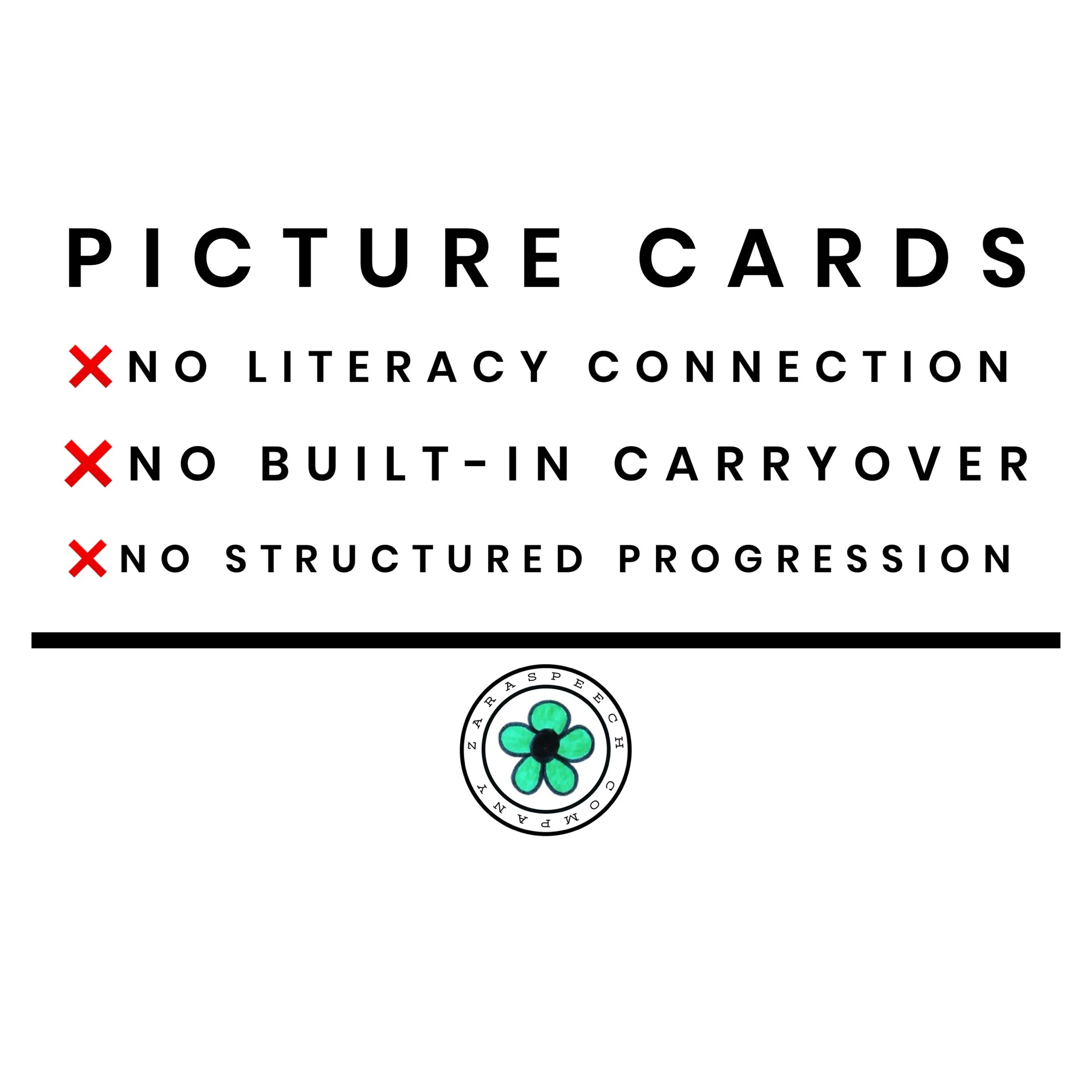
SPEECH THERAPY THAT GOES BEYOND PICTURE CARDS
Tikanis! I am ZARAS, an ASHA certified Speech-Language Pathologist and the creator of OPPA®—a structured, print-rich articulation system designed to build real carryover by connecting speech sounds, letters, and language.

What is OPPA®?
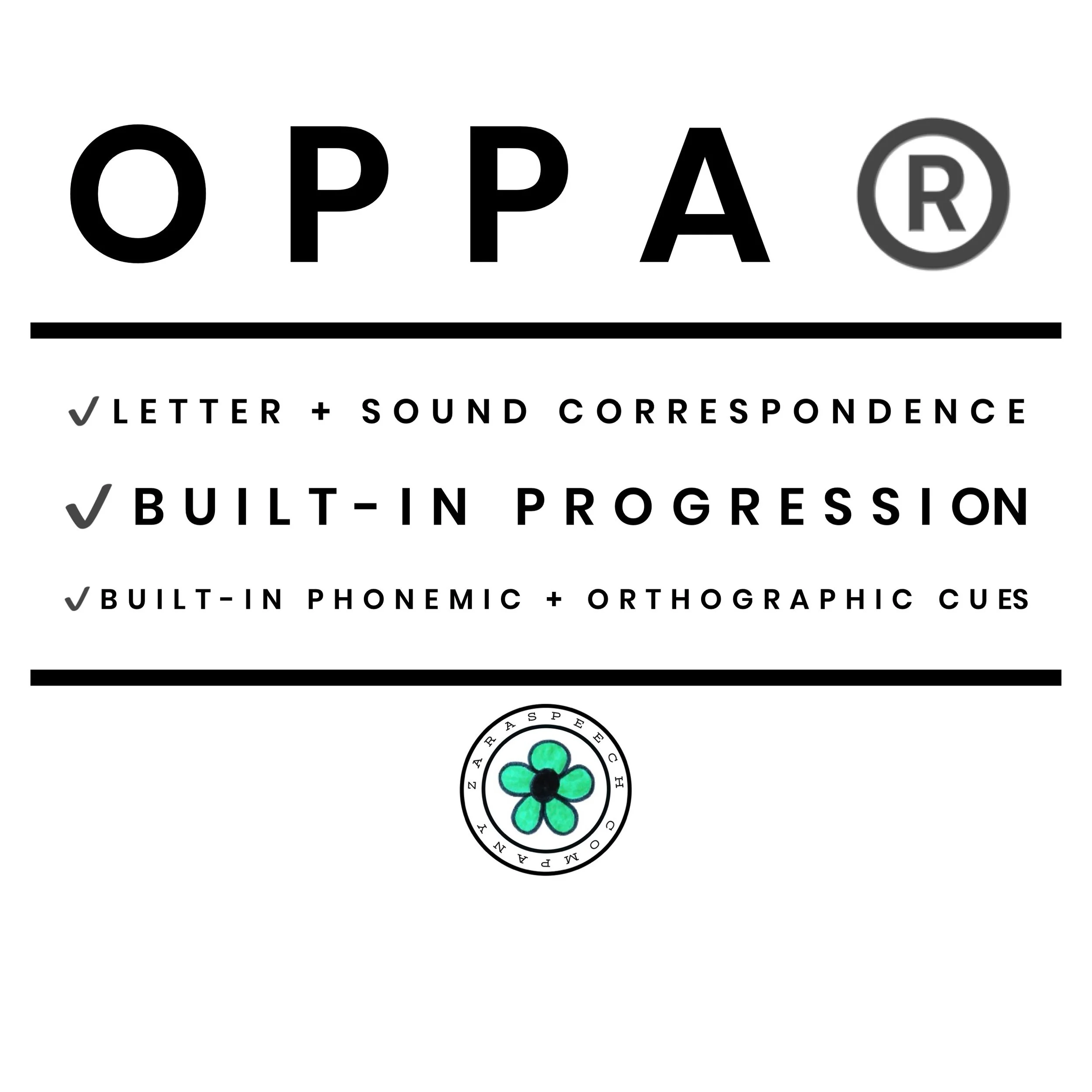
OPPA® is not just another word list or deck of cards for speech sound intervention. In Greek, the expression “opa” is an exclamation of celebration. OPPA® is the celebration of the connection between reading and speaking. Created by an ASHA Certified Speech-Language Pathologist, OPPA® facilitates the simultaneous development of skilled reading and articulation through the pillars of motor learning. OPPA® is suitable for the school-age population; however, OPPA® may also be presented orally to individuals who are learning to read. Individual results may vary due to the unique nature of speech sound mispronunciations and/or reading difficulties.
Why OPPA®?
The American Speech-Language Hearing Association (ASHA) explains that 11% to 40% of children diagnosed with speech sound disorders also exhibited language impairments(Eadie et al., 2015; Shriberg et al., 1999). ASHA further cites that speech sound production difficulties in kindergarten are associated with decreased literacy achievements (Overby, Trainin, Smit, Bernthal, & Nelson, 2012).
-
Arranging the stimuli in a predictable context. OPPA® Drill Book I and OPPA® Articulation Cards incorporate blocked practice in the word lists.
-
Arranging the stimuli in unpredictable contexts. OPPA® Drill Book I and OPPA® Articulation Cards incorporate random practice in the phrase and sentence lists.
-
Word Recognition involves phonological awareness, decoding, and sight recognition.
-
Language Comprehension involves background knowledge, vocabulary, syntax, semantics, verbal reasoning, and literacy knowledge.
-
Skilled Reading is the automatic and simultaneous act of recognizing and understanding the written code of language.
-
Can print rich speech-language therapy materials be used with non-readers?
Absolutely! Just because a child does not read yet, does not mean that you cannot read to them. For example, using the written format of articulation sounds provides the opportunity to practice phonological awareness and/or phonemic awareness with your child. Read the word to them and have them imitate your models.
Why do you put “and” in all of your articulation phrases?
“And” actually promotes random practice. The purpose of the phrase and sentence cards in my articulation decks is to help your child generalize accurate articulation to the conversational or connected speech level.
The little word “and” happens to be very frequently used in the English language. EnglishClub lists “and” as the #1 most common conjunction.
“And” is in our English language because, well, we as humans do not typically speak in single or isolated words. I have first-hand experience with children who can tell me “the-the-the” many times in a row with excellent accuracy; however, as soon as we add the word “and” in-between (example: “the and the”), accuracy declines. It is in my clinical view that “and” repositions the articulators (in the case of “the” would involve a change in tongue position) which mimics the quick reposition that must occur during connected speech or conversational speech.
Why do you use print rich materials in speech and language intervention?
At first it was developed out of necessity—many of my students with articulation and language deficits were struggling with reading. On the flip side, I also had many students who could read but they did not always understand what they were reading. I found that the best way to connect speaking and reading and language was to actually, read.
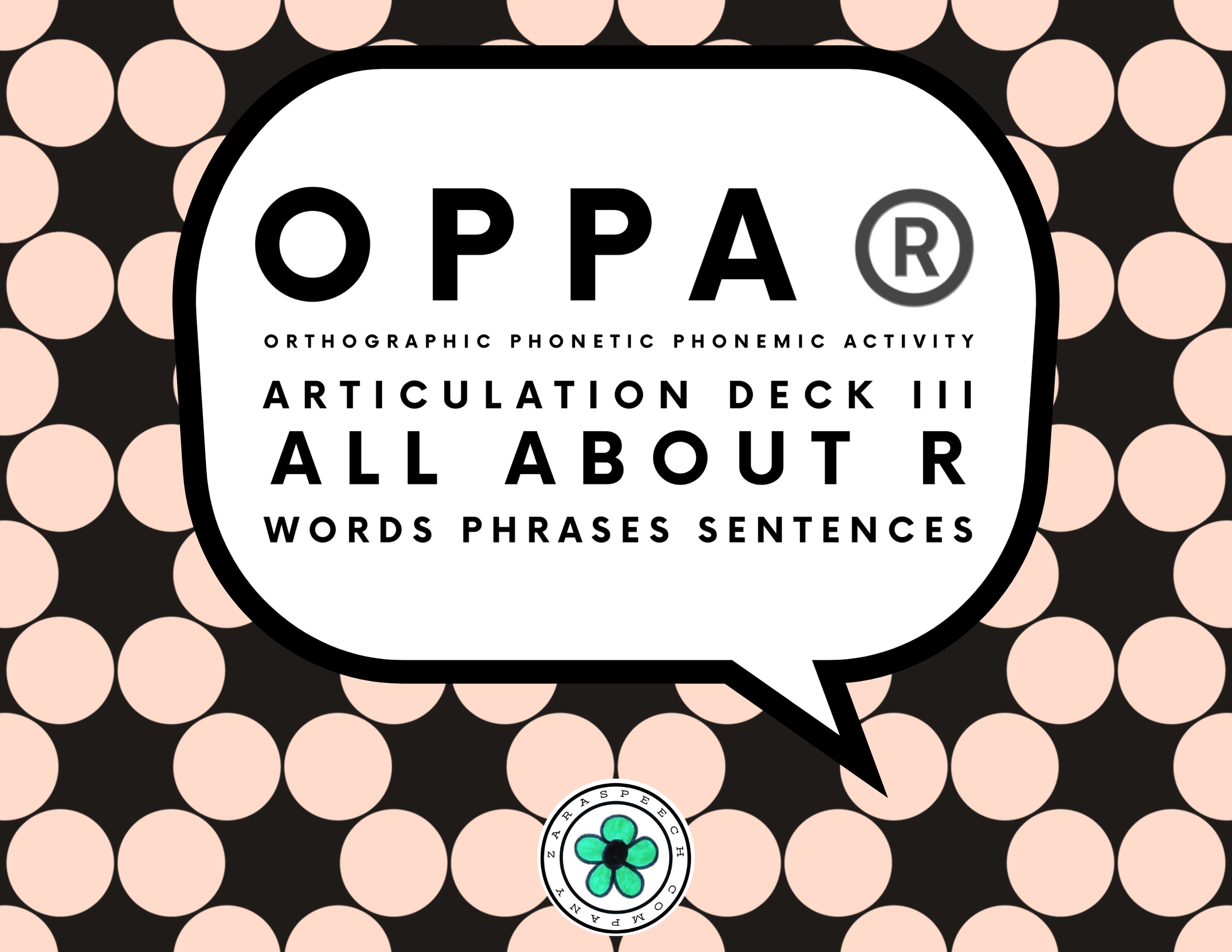
Created by an ASHA Certified Speech-Language Pathologist, Orthographic Phonetic Phonemic Activity® facilitates the simultaneous development of skilled reading and articulation through the pillars of motor learning. OPPA® is suitable for the school-age population; however, OPPA® may also be presented orally to those who are learning to read.
OPPA® All About R deck includes all rhyming words! Comprehensive collection of the Prevocalic R speech sounds: /ri, ro, ru, ra, reɪ, raɪ, rɛ, ræ, rʌ, rɪ/. Vocalic and Postvocalic R sounds: EAR, IRE, AIR, AR, ER, OR are also included. This resource covers all word positions and includes two levels of difficulty of phrases and sentences. Phrases and sentences are based on the word list, which affords hundreds of opportunities for repetition.
EXAMPLE PREVOCALIC R:
Word: read
Phrase Level 1: real and read
Phrase Level 2: real reap and read
Sentence Level 1: I like to read.
Sentence Level 2: I read real books.
EXAMPLE VOCALIC R:
Word: heart
Phrase Level 1: cart and heart
Phrase Level 2: heart cart and tart
Sentence Level 1: His heart is beating.
Sentence Level 2: I love the heart tart.
EXAMPLE POSTVOCALIC R:
Word: hair
Phrase Level 1: fair and hair
Phrase Level 2: fair hair and wear
Sentence Level 1: He has red hair.
Sentence Level 2: I wear the clown hair.
UNIQUE FEATURES:
Word positions are labeled using the terms Beginning, Middle, End.
Each phoneme family is written in bold for emphasis.
Each word card is paired.
Phrase and sentence cards are written as a checklist.
All cards are written and measure approximately 3 X 5 inches.
136 black and white PDF document.
OPPA® is a Registered Trademark of ZARASpeech Company Corporation. All Rights Reserved.

Created by an ASHA Certified Speech-Language Pathologist, Orthographic Phonetic Phonemic Activity® facilitates the simultaneous development of skilled reading and articulation through the pillars of motor learning. OPPA® is suitable for the school-age population; however, OPPA® may also be presented orally to those who are learning to read.
Comprehensive collection of the blend speech sounds: /gr, kr, dr, tr, fr, pr, br, thr, shr, str, skr, spr, st, sk, sp, sm, sn, sw, sl, pl, bl, kl, gl, fl/. This resource covers the beginning word position and includes two levels of difficulty of phrases and sentences. Phrases and sentences are based on the word list, which affords hundreds of opportunities for repetition.
EXAMPLE:
Word: blue
Phrase Level 1: blur and blue
Phrase Level 2: blue bloom and blew
Sentence Level 1: My bag is blue.
Sentence Level 2: The blue paper is blank.
UNIQUE FEATURES:
Word positions are labeled using the term Beginning.
Phonetic symbol for each blend is also provided on each word card.
Target phoneme is written in bold for emphasis.
Each word card is paired.
Phrase and sentence cards are written as a checklist.
All cards are written and measure approximately 3 X 5 inches.
154 page PDF document.
© ZARASpeech Company All Rights Reserved

Created by an ASHA Certified Speech-Language Pathologist, Orthographic Phonetic Phonemic Activity® facilitates the simultaneous development of skilled reading and articulation through the pillars of motor learning. OPPA® is suitable for the school-age population; however, OPPA® may also be presented orally those who are learning to read.
Comprehensive collection of essential speech sounds: /k, g, f, v, s, z, ʃ (sh), tʃ (ch), θ (th), ð (th), l, w/. This resource covers all word positions (exception: beginning and middle for /w/) and includes two levels of difficulty of phrases and sentences. Phrases and sentences are based on the word list, which affords hundreds of opportunities for repetition.
EXAMPLE:
Word: cat
Phrase Level 1: cat and cane
Phrase Level 2: cat cab and cane
Sentence Level 1: The cat went away.
Sentence Level 2: The cat went into the cave.
UNIQUE FEATURES:
Word positions are labeled using the terms Beginning, Middle, End.
Phonetic symbol for speech sound is provided on each word card.
Target phoneme in bold for emphasis.
Each word card is paired.
Phrase and sentence cards are written as a checklist.
All cards are written and measure approximately 3 X 5 inches.
213 page PDF document.
OPPA® is a Registered Trademark of ZARASpeech Company. All Rights Reserved.

Created by an ASHA Certified Speech-Language Pathologist, Orthographic Phonetic Phonemic Activity® facilitates the simultaneous development of skilled reading and articulation through the pillars of motor learning. OPPA® is suitable for the school-age population; however, OPPA® may also be presented orally to those who are learning to read.
Comprehensive collection of early speech sounds: /dʒ (j), m, n, p, b, t, d/ This resource covers all word positions and includes two levels of difficulty of phrases and sentences. Phrases and sentences are based on the word list, which affords hundreds of opportunities for repetition.
EXAMPLE J DECK:
Word: soldier
Phrase Level 1: angel and soldier
Phrase Level 2: magic pages and soldier
Sentence Level 1: The soldier is marching.
Sentence Level 2: The soldier sent messages.
UNIQUE FEATURES:
Word positions are labeled on each card using the terms Beginning, Middle & End.
The phonetic symbol for each sound is also entered on each word card.
The target phoneme is written in bold for emphasis.
Each word card is paired.
Phrase and sentence cards are written as a checklist.
All cards are written and measure approximately 3 X 5 inches.
130 page black and white PDF document.
OPPA® is a Registered Trademark of ZARASpeech Company. All Rights Reserved.


HUNDREDS OF TARGETS

ALSO AVAILABLE IN PRINT

ZARASpeech Company presents the paperback version of the Amazon Kindle OPPA® Articulation Drill Book I. This comprehensive speech exercise book is intended for anyone who wants to improve their pronunciation of Standard American English. Presented in a written format sans pictures, OPPA® Articulation Drill Book I covers the following English consonants: /k/, /g/, /f/, /v/, /s/, /z/, /ʃ/ (sh), /tʃ/ (ch), /l/, /w/, unvoiced /θ/ (th) and voiced /ð/ (th). Readers progress systematically from the word, phrase, and sentence levels to achieve accurate pronunciation. Strategies to elicit optimal pronunciation are also provided.
Features:
187 total pages are bound by durable plastic coil
Clear plastic front cover with black plastic back cover
Printed on premium 28 lb paper
Ships within 3-5 business days from North Carolina
Printed and assembled in the USA
USA orders ship free. Please allow up to 5 business days to manufacture and ship item.
RESEARCH
American Speech-Language-Hearing Association. (n.d.). Speech sound disorders: Articulation and phonology. Speech Sound Disorders: Articulation and Phonology. Retrieved July 27, 2022, from https://www.asha.org/practice-portal/clinical-topics/articulation-and-phonology/#collapse_8
Eadie, P., Morgan, A., Ukoumunne, O. C., Eecen, K. T., Wake, M., & Reilly, S. (2015). Speech sound disorder at 4 years: Prevalence, comorbidities, and predictors in a community cohort of children. Developmental Medicine & Child Neurology, 57, 578–584.
Esperger, J. (n.d.). 25 most common conjunctions. EnglishClub. Retrieved September 25, 2021, from https://www.englishclub.com/vocabulary/common-conjunctions-25.htm.
“Language, Reading, and Learning in School: What the Speech-Language Pathologist Needs to Know.” Language Disorders from Infancy through Adolescence: Listening, Speaking, Reading, Writing and Communicating, by Rhea Paul and Courtenay Frazier Norbury, Mosby, 2012, pp. 409–411.
Maas, E., Robin, D.A., Austermann Hula, S.N., Freedman, D.E., Wulf, G., Ballard, K.J., & Schmidt, R.A. (2008). The principles of motor learning in treatment of motor speech disorders. American Journal of Speech-Language Pathology, 17, 277-298.
Overby, M.S., Trainin, G., Smit, A. B., Bernthal, J. E., & Nelson, R. (2012). Preliteracy speech sound production skill and later literacy outcomes: A study using the Templin Archive. Language, Speech, and Hearing Services in Schools, 43, 97–115.
“The Reading Rope” from Scarborough H. (2003). Connecting early language and literacy to later reading disabilities: evidence, theory, and practice. S. Newman & D. Dickenson (Eds.) Handbook of Early Literacy Research (pp. 97-110). New York: Guilford Press.
Shriberg, L. D., Tomblin, J. B., & McSweeny, J. L. (1999). Prevalence of speech delay in 6-year-old children and comorbidity with language impairment. Journal of Speech, Language, and Hearing Research, 42, 1461–1481.


